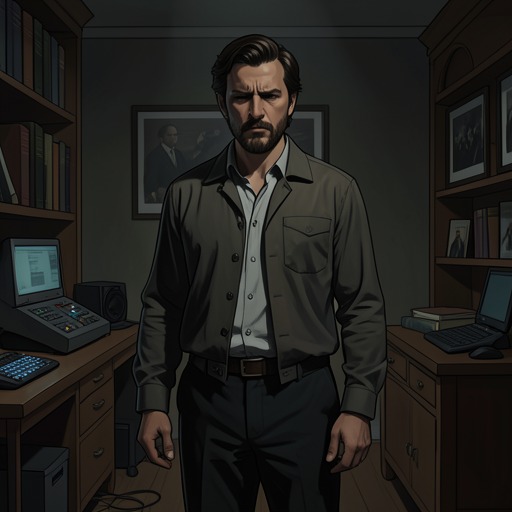
Vehi Fairfield
Inherent ViceVehi Fairfield is a longboarder, psychedelic teacher, and self-styled source of insight whose importance lies in the way he connects Doc Sportello’s search for Shasta Fay to the novel’s submerged histories and unstable visions. For Sortilège, he is the closest thing to a real oracle in the area; for Doc, he is also an unsettling figure from an old, “weird history.” Vehi’s acid use is not incidental to his authority: it is the medium through which he claims to see, and the means by which he sets Doc on a journey that blurs revelation with a drug-induced vision.
Identity and Countercultural Authority
Vehi is presented through the people who interpret him. Sortilège calls him a teacher and insists that his acid use helps him see, while Spike offers the more guarded assessment that Vehi is okay, though he takes a great deal of acid. Doc’s response is less reverent. He suspects that Sortilège’s recommendation may be colored by her loyalty to her teacher, and he has reason to feel wary: he tells her that he and Vehi have a strange history. Vehi, for his part, thinks Doc has been avoiding him and does not understand why. Their meeting therefore carries an existing tension beneath the apparent ease of the countercultural setting.
Vehi’s authority also has a practical side. When Doc needs to speak with someone after hearing that Shasta has left the country, Sortilège names Vehi as the person who may help him. She later says that if anyone can put Doc in touch with Shasta Fay, it is Vehi. He is not simply a teacher who offers abstract spiritual ideas; he is treated as a point of access to knowledge and connections unavailable to Doc through ordinary investigation.
The Acid Medium and Lemurian Belief
The narrative describes Vehi as living in LSD rather than merely experimenting with it. He receives acid from Laguna Canyon, possibly through a special pipeline, from the psychedelic network believed to operate there after Owsley. His systematic daily tripping has led him to a spirit guide named Kamukea, a Lemuro-Hawaiian demigod associated with the earliest history of the Pacific and with the lost continent of Lemuria, now said to lie beneath the ocean. The account gives Vehi’s beliefs an elaborate mythic framework, but does not establish them as objective fact; they arrive within a story where intoxication, spiritual conviction, and uncertain perception remain entangled.
That framework is connected to a theory of planetary history. Vehi’s teaching holds that Atlantis and Lemuria sank because Earth could no longer accept the toxicity those empires had produced. In conversation, the idea appears as a warning about the present: Earth has an immune system and may eventually reject destructive agents such as the oil industry. The ancient continents are thus not just lost places in Vehi’s cosmology; they become precedents for a future in which human damage provokes a larger corrective force.
Encounter with Doc
When Doc and Sortilège reach Vehi, he appears as a shaved-headed person wearing wire-rim sunglasses and a green-and-magenta kimono with a bird motif. He is an old-school longboarder recently returned from Oahu, and he had somehow known in advance about the major surf that struck the island’s North Shore in December. The details make his reputation feel at home in a world where surf knowledge, intuition, and prophecy can run together.
Vehi and Doc discuss two apparently separate events: the arrest of Charlie Manson and the great surf of 1969. Vehi proposes that separate worlds, each unaware of the other, nevertheless connect somewhere; Doc supplies the pairing, and Vehi says he would be surprised if the events were not connected. The exchange condenses Vehi’s way of reading the world. Coincidence becomes a possible hidden relation, and the distance between countercultural spectacle and political violence becomes something to investigate rather than accept as a boundary.
The Blotter and the Vision
Vehi gives Doc a piece of blotter marked with writing Doc cannot identify as Chinese or perhaps Japanese. Doc treats the offer with sarcasm and asks whether it will produce another science-fiction experience. Vehi answers that this one is designed expressly for him. Doc takes it, only then asking what that means. Vehi’s promise is followed not by an explanation but by an uncanny disappearance: as Tiny Tim’s “The Ice Caps Are Melting” repeats at full volume on Doc’s stereo, Vehi has either left or become invisible.
The ensuing vision gives Vehi’s spiritual framework a narrative consequence. Doc moves through an immense, dampening city structure as the water rises around him, eventually understanding that the whole place is sinking. He curses Vehi for setting him up once again, then perceives Kamukea as a shadow of deep clarity. The guide tells him they must leave. The scene translates the myth of Lemuria’s inundation into an immediate ordeal: the lost world is not only a theory Vehi has taught, but a landscape Doc experiences as it disappears beneath the water.
In the vision, Doc and Kamukea fly above the Pacific and see a schooner running under full sail. Doc recognizes it as the Golden Fang, but Kamukea corrects him: it is the Preserved. Shasta is on deck, alone and apparently brought there under duress, looking back toward the home she has left. Doc tries to call to her, but words cannot reach her in that space. Kamukea assures him she will be all right and tells him that he must learn what is being shown to him. The episode leaves Vehi’s intervention suspended between drug experience and meaningful disclosure: it does not resolve the vision into a conventional clue, but binds his teaching to Doc’s concern for Shasta and to the book’s recurring uncertainty about what can be known.